About Data
Chat with CSR Data
Ask questions. Get answers. Generate visualisations. No spreadsheets needed. This platform lets you chat with CSR data sourced from the National CSR Portal and curated by Dataful.
Why Chat with CSR Data?
Instant Insights
No more searching through millions of rows. Get answers and customised data tables in seconds through natural conversation.
No Technical Knowledge Needed
Just chat with the data like you would with a colleague — no coding or analytics expertise required.
On-demand Downloads
Interact with your data through chat and download the tables generated from your conversations.
Wide Coverage
Access data from 45,000+ companies across different sectors in India.
What Data is Available?
Company-Level CSR Data
Average net profit, CSR prescribed vs. actual spent, company-wise project types and expenditure.
Geographic Data
Year-, state-, and district-wise CSR spending; state- and district-level project details.
Sectoral Data
CSR expenditure by sector (education, health, environment, etc.); state- and district-level sectoral allocation.
Time Series Data
Year-wise CSR prescribed and spent (2014-15 to 2024-25), trends in spending over time, and growth/decline patterns in CSR participation.
Project-Level Data
Individual project details, including implementing mode, location, sector, and expenditure.
How It Works
- 1
Ask Your Question
Type your question in natural language — no technical jargon or specific coding language needed.
- 2
AI Analyses
Our smart system analyses your question and identifies exactly what CSR data and metrics you need.
- 3
Searches Database
Your query runs against Dataful's cleaned and standardised CSR database — thousands of company reports processed into consistent, comparable data.
- 4
Get Instant Results
Receive relevant insights along with customised data tables, charts and visualisations, or ask follow-up questions to explore deeper.
Who is it for?
What is CSR?
Understanding CSR in India
Corporate Social Responsibility (CSR) is mandated under Section 135 of the Companies Act, 2013. It requires companies meeting any of the following thresholds to spend at least 2% of their net average profit on social development:
- Net Worth: ₹500 crore or more
- Turnover: ₹1,000 crore or more
- Net Profit: ₹5 crore or more
CSR aims to drive responsible corporate conduct by funding projects like:
- Education & Skill Development
- Health & Sanitation
- Environmental Sustainability
- Rural & Urban Development
- Water Conservation & Heritage Protection
Journey of CSR Data
- 1
Planning & Spending
Eligible companies calculate their 2% CSR obligation, plan CSR projects (via the CSR Committee), execute them through in-house teams or implementing agencies, and spend during the financial year.
- 2
Recording & Documentation
Teams maintain project-wise records: amounts sanctioned vs. spent, locations, timelines, implementing partners, and outcomes.
- 3
Board Reporting
A concise CSR section/annexure is prepared for the Board's Report, summarising projects, spend vs. obligation, and any unspent amounts with reasons.
- 4
Statutory Filing
The company submits CSR details to the Ministry of Corporate Affairs — primarily through e-Form CSR-2 (alongside annual filings) — capturing project and spending particulars.
- 5
Data Consolidation
The Ministry of Corporate Affairs compiles and consolidates all company filings into a structured CSR database.
- 6
Public Availability
The consolidated CSR data is published on the National CSR Portal, accessible to policymakers, researchers, and the public.
About the Data
The Ministry of Corporate Affairs (MCA) is responsible for the administration of companies under the Companies Act 2013 and other allied laws. Under the same Act, the MCA governs the implementation of Corporate Social Responsibility (CSR) policy and the projects undertaken by companies.
The data sources for these datasets are the periodical CSR Reports published by MCA. The MCA collects the reports submitted by companies registered under CSR and compiles them to publish periodical reports.
Disclaimers by MCA about the Data
- Data Cleaning
- The data has been technically cleaned by removing errors, as far as feasible, especially with respect to the development sector, states, etc.
- Source of Data
- The data is sourced from company disclosures made in Segment II of e-form AOC-4 (both XBR and Non-XBR formats).
- Final Disclosure Reference
- The Board Report should be considered as the final and authoritative disclosure.
- No Guarantee of Accuracy
- The Ministry of Corporate Affairs (MCA) does not guarantee the completeness or accuracy of the data provided on the portal.
- Error Possibility
- MCA does not claim the data will be free from errors.
- Precedence of Director's Report
- If there is any discrepancy between the data on the portal and the company's Director's Report, the Director's Report will take precedence.
- NLC / Not Mentioned
- Refers to companies that have not disclosed project details as required under Section 135 of the Companies Act, 2013 and CSR Rules, 2014.
- PAN India Tag
- Applies to companies that mention CSR contributions to national-level funds (e.g., PM's National Relief Fund, Swachh Bharat Kosh, Clean Ganga Fund), and to companies that report CSR activity across multiple states for a single project.
Standardised CSR Datasets Available on Dataful
You are currently exploring CSR data through CSR Insights, a tool powered by Gopie, using cleaned and standardised datasets from Dataful. These datasets are structured and standardised to enable easy analysis across multiple dimensions such as year, state, sector, company type, and geography.
Year-, State-, District- and Company-wise Types of Projects Taken Up, Amount Outlaid and Spent
Fields: Fiscal year, State Names, District Names, CSR Project Names, Sectors, Company Names, Corporate Identification Numbers (CIN), Implementation Mode, Project Amount Outlay, and CSR Amount Spent.
Year-, State-, Company-, Class- and Company-Type-wise Names of Companies Registered under CSR
Fields: Fiscal year, State Names, ROC Names, Company Names, Corporate Identification Numbers (CIN), Company Class, Company Types, and Listing Status.
Year- and Company-wise Average Net Profit, CSR Amount Prescribed and Spent (by Local area and Overall)
Fields: Fiscal year, Company Names, Corporate Identification Numbers (CIN), Average Net Profit, Prescribed CSR Expenditure, CSR Amount Spent, and Amount Spent in Local Area.
Year- and Company-wise Total Amount Spent
Fields: Fiscal year, Company Names, Corporate Identification Numbers (CIN), and CSR Amount Spent.
Year-, State-, District- and Sector-wise Amount Spent
Fields: Fiscal year, State Names, District Names, Type of District, Sector Group, and CSR Amount Spent.
Year- and State-wise Total Amount Spent
Fields: Fiscal year, State Names, and CSR Amount Spent.
Year- and Sector-wise Total CSR Amount Spent
Fields: Fiscal year, Sectors, and CSR Amount Spent.
Year-wise Total Number of PSU and Non-PSU Companies Registered and the Total CSR Amount Spent by them
Fields: Fiscal year, Company Category, Number of Companies, and CSR Amount Spent.
Dataful's Data Cleaning & Reconciliation
While the CSR portal of the Ministry of Corporate Affairs (MCA) provides CSR data, it has multiple data quality issues — duplicate records, inconsistent company names, and CIN changes over time. Dataful tracks corporate events such as mergers, demergers, listing changes, and restructurings to create a consistent, deduplicated view of companies across the full time series.
When Does a Company's CIN Change?
A CIN is a unique 21-character alphanumeric identifier assigned at incorporation. While it generally stays fixed, four events trigger a new CIN:
Change in Listing Status
When an unlisted company becomes listed, or a listed company is delisted, the 1st character of the CIN changes from U (Unlisted) to L (Listed) or vice versa.
Change in Registered Office State
If a company shifts its registered office from one state to another, the state code in the CIN changes. Requires compliance with Section 13 of the Companies Act, 2013.
Conversion Between Private and Public Company
When a company converts between private and public status, the company type component of its CIN is updated. Governed by Section 14 of the Companies Act, 2013.
Change in Principal Business Activity
If the MCA updates the National Industrial Classification (NIC) code for a company's principal business activity, the CIN is updated to reflect the revised classification.
Changes that do NOT result in a new CIN
- Change in company name (Section 13 of the Companies Act, 2013)
- Change in directors or key managerial personnel
- Increase or decrease in authorised or paid-up share capital
- Change in shareholding pattern
- Relocation of the registered office within the same state
How Dataful Cleans the Data
Market Listing Reconciliation
Identifies and merges records when a company's listing status changes (L ↔ U prefix in CIN) to ensure continuity across the time series.
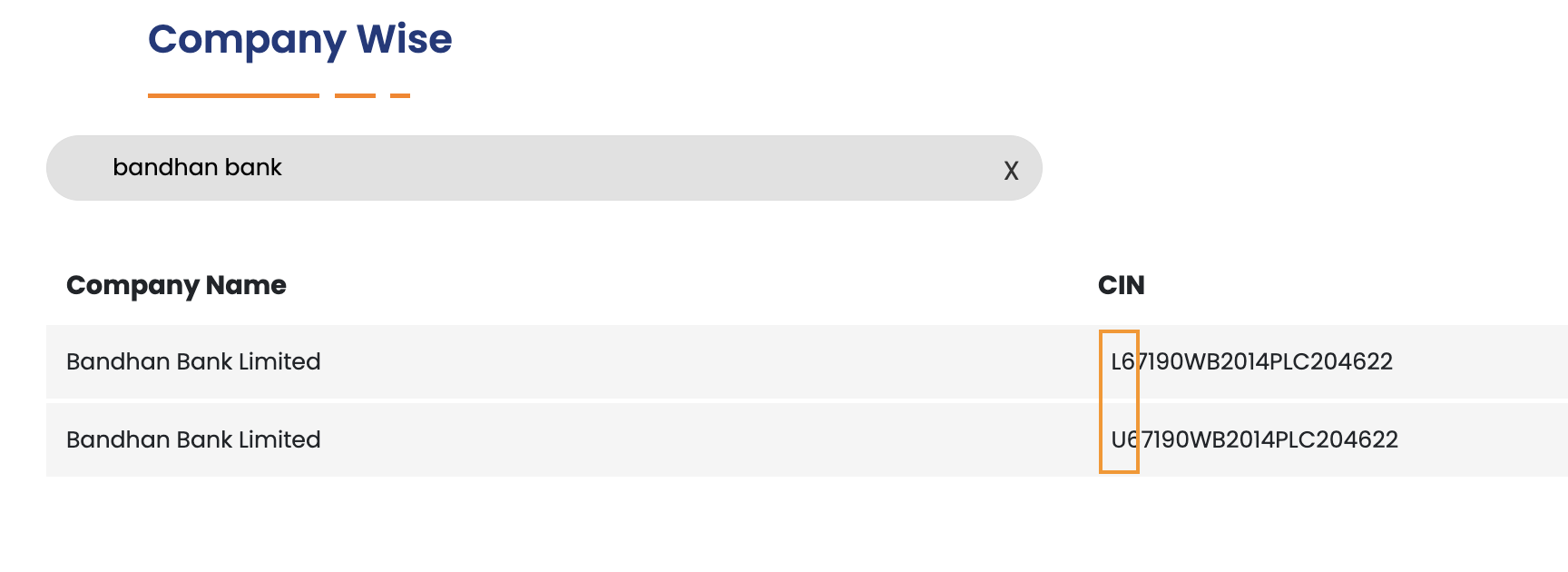
Same company appears twice — once as Listed (L) and once as Unlisted (U)
Standardisation
Cleans unstructured or inconsistently formatted names to prevent duplicate entries that the CSR portal treats as separate entities.
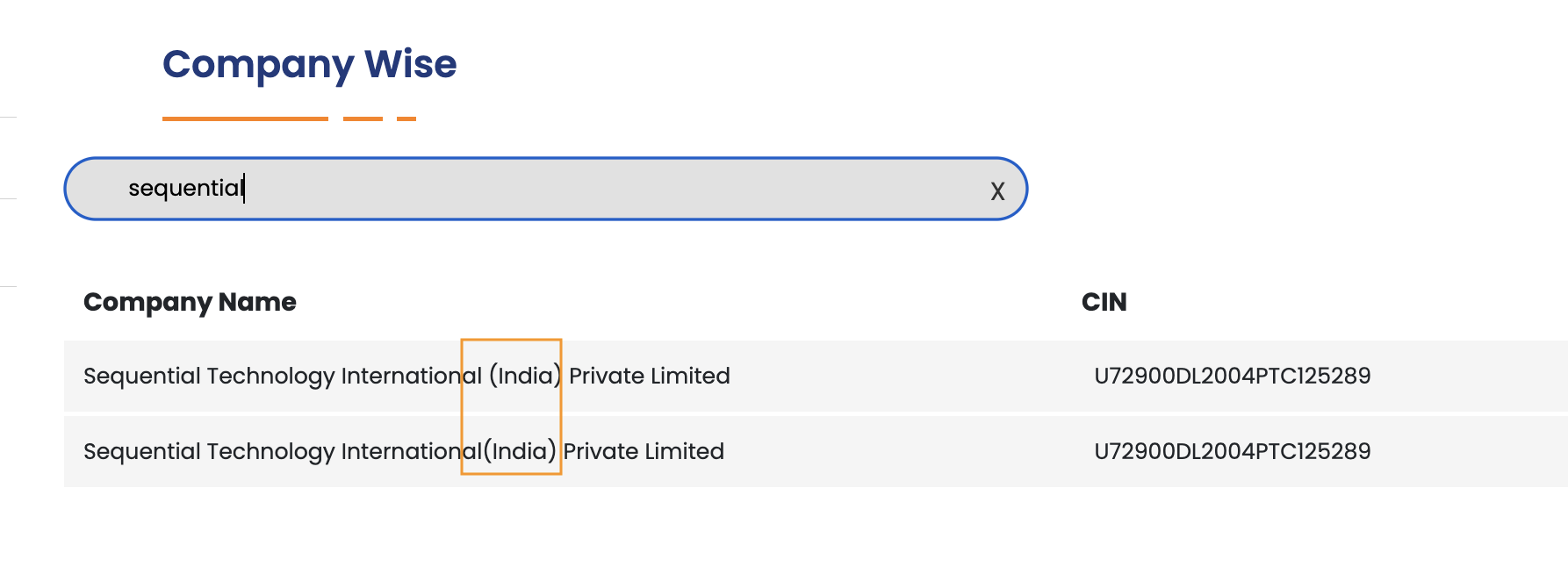
Same CIN, same company — treated as separate due to spacing differences around "(India)"
Entity Normalisation
Variations of the same company name — full versions vs. abbreviated versions — are grouped together as a single entity.
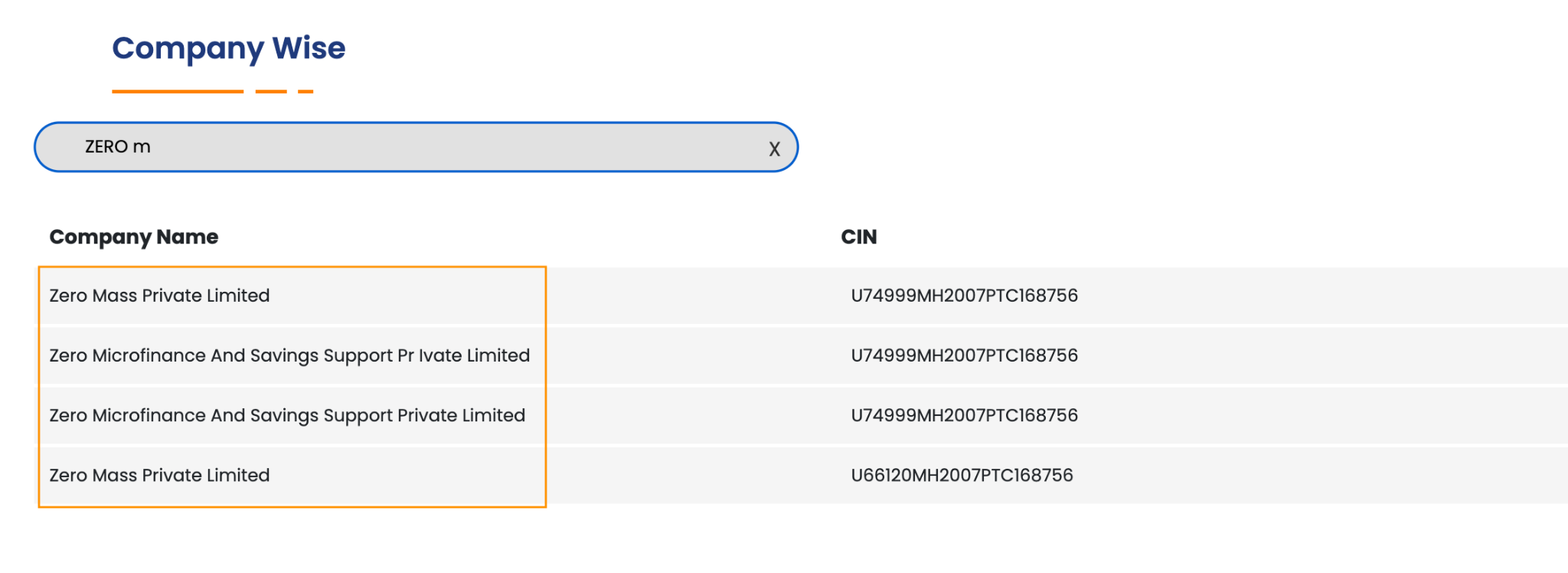
Abbreviated and full forms of the same entity treated as separate companies
Merger Management
Merged companies: All historical and future data is attributed to the successor entity. For example, Bharti Infratel Limited officially merged with Indus Towers Limited on 19 November 2020. Dataful includes only Indus Towers Limited throughout the historical data — the official portal reports both separately, causing duplication.
Demerged companies: Entities are retained separately, with all future data reported independently from the year of demerger.